Case File
Constantine Didn't Build This — The Truth About Nicaea
The Sources
Every claim in the video, and where it came from. Solid ground is stated plainly. Open questions are marked as open.
Constantine and the Persecutions
- Constantine became emperor in 306 AD, proclaimed by his troops at York after the death of his father Constantius. He consolidated power over the following years, defeating Maxentius at the Milvian Bridge in 312.
- Nearly 250 years of persecution. From Nero's scapegoating of Christians after the Great Fire of Rome (64 AD) through the empire-wide Great Persecution under Diocletian (beginning 303 AD), Christians faced intermittent arrest, torture, and execution for refusing to renounce the faith, for roughly two and a half centuries before Constantine.
- Nero and the fire. The Roman historian Tacitus (Annals 15.44) records that Nero blamed Christians for the fire of 64 AD and had them executed in brutal public spectacles.
- Diocletian's persecution (303-311 AD) was the most systematic and brutal, involving the destruction of churches and scriptures, imprisonment of clergy, and empire-wide demands for sacrifice to the Roman gods.
Sources: Tacitus, Annals 15.44; Eusebius, Ecclesiastical History 8; standard Roman histories.
The Edict of Milan
- 313 AD. Constantine and Licinius issued what is called the Edict of Milan, granting religious tolerance across the empire. It did not establish Christianity; it made it legal, ending the persecutions. Property confiscated from Christians was to be restored.
- "He didn't invent Christianity. He stopped trying to kill it." The video's line on this point is historically sound: Christianity had grown for nearly three centuries under persecution before any emperor favored it.
- Constantine's baptism. He was not baptized until his deathbed in 337 AD, by Eusebius of Nicomedia, a delay that was not unusual among early Christians of his era.
Sources: Eusebius, Life of Constantine ; Lactantius, On the Deaths of the Persecutors 48.
The Council of Nicaea
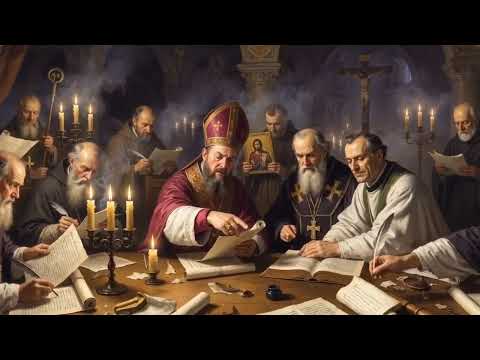
- 325 AD. Constantine convened the council at Nicaea (in modern-day Turkey) to settle the dispute caused by Arius, a priest from Alexandria teaching that Jesus was a created being, not eternal, not fully God.
- Only two refused to sign. Of the roughly 300 bishops present (tradition holds 318), only two, Theonas of Marmarica and Secundus of Ptolemais, refused to sign the Nicene Creed. The divinity of Christ was not a close vote; it was the overwhelming consensus of the church.
- An old heresy voted out, not a new idea voted in. The council's creed affirmed what the majority of churches had already taught for generations. Arius's position was the novelty being rejected.
Sources: Eusebius, Life of Constantine 3; the text of the Nicene Creed (325); standard church histories.
The Canon Was Not on the Agenda
- Nicaea did not decide the biblical canon. No ancient source lists the canon among the council's business. The claim that Constantine or Nicaea chose the books of the Bible has no historical basis.
- The core was recognized early. By the late 100s AD, over 150 years before Constantine, the four Gospels, Acts, Paul's letters, and most of the New Testament were already widely recognized and quoted by church fathers such as Irenaeus. The Muratorian Fragment (circa 170 AD) lists most of the New Testament books as authoritative.
- Gradual recognition. The process of recognizing the canon stretched over centuries, through usage and consensus in the churches, long before and after Constantine. He did not pick the books and did not rewrite them.
Sources: the Muratorian Fragment (c. 170 AD); Irenaeus, Against Heresies (c. 180 AD); standard New Testament introductions.
Follow the Investigation
New cases drop on every platform. Pick yours.
The Host’s Ledger
Everything Blood Covered, straight to your inbox. New investigations, new music, merch, announcements. If it happens, the ledger hears it first. No noise, unsubscribe any time.
Your name is in the ledger. Watch your inbox.
Your address goes in the host’s book and nowhere else.
Watch the Video
Constantine Didn't Build This — The Truth About Nicaea on YouTube. Also on Rumble.